 |
| Nevada Biscuitroot (Lomatium nevadense) |

Showing posts with label Plants. Show all posts
Showing posts with label Plants. Show all posts
2/25/14
First Wildflower 2014
I found my first wildflower of 2014 on 2/16/2014, in the Virginia/Flowery Range. It is a lomatium which is not unusual for our area, in years past it is typically one of the first bloomers I see.


National Invasive Species Week!
From: http://www.nisaw.org/
National Invasive Species Awareness Week is scheduled for February 23-28. And according to experts with the Weed Science Society of America (WSSA), it's a topic that deserves our attention. Non-native plants, animals and pathogens can harm humans and the environment and impact our nation's economy. The damage done by invasive plants alone costs the U.S. an estimated $34.7 billion a year.
Invasive weeds can produce skin irritation, trigger allergies and poison pets and livestock. They can clog waterways, kill native trees, and shade out crops, ornamentals and prized native flora. They are found in every imaginable habitat, including oceans, lakes, streams, wetlands, croplands, rangelands, natural areas, parks, forests, urban environments, yards and gardens.
"Though the impact of invasive species is profound, there are important steps we can take to manage infestations and prevent their spread," says Lee Van Wychen, Ph.D., director of science policy for the WSSA. "It all begins with awareness."
Eight Ways You Can Help
National Invasive Species Awareness Week is scheduled for February 23-28. And according to experts with the Weed Science Society of America (WSSA), it's a topic that deserves our attention. Non-native plants, animals and pathogens can harm humans and the environment and impact our nation's economy. The damage done by invasive plants alone costs the U.S. an estimated $34.7 billion a year.
Invasive weeds can produce skin irritation, trigger allergies and poison pets and livestock. They can clog waterways, kill native trees, and shade out crops, ornamentals and prized native flora. They are found in every imaginable habitat, including oceans, lakes, streams, wetlands, croplands, rangelands, natural areas, parks, forests, urban environments, yards and gardens.
"Though the impact of invasive species is profound, there are important steps we can take to manage infestations and prevent their spread," says Lee Van Wychen, Ph.D., director of science policy for the WSSA. "It all begins with awareness."
Eight Ways You Can Help
- Learn about invasive species, especially those found in your region. Your county extension office (http://www.csrees.usda.gov/Extension/index.html) and the National Invasive Species Information Center (http://www.invasivespeciesinfo.gov/index.shtml) are both trusted resources.
- Clean hiking boots, waders, boats and trailers, off-road vehicles and other gear to stop invasive species from hitching a ride to a new location.
- Avoid dumping aquariums or live bait into waterways.
- Use forage, hay, mulch and soil that are certified as "weed free."
- Plant only non-invasive plants in your garden, and remove any known invaders.
- Report new or expanded invasive species outbreaks to authorities. (See http://www.invasive.org/report.cfm for a state-by-state list of contacts.)
- Volunteer to help remove invasive species from public lands and natural areas.
- Ask your political representatives at the state, local and national level to support invasive species control efforts.
2/24/14
Lagomarsino Petroglyphs
Last weekend, the weekend of February 16, 2014 Dan, Coco and I hiked 13 miles round trip to the Lagomarsino petroglyphs. Now, we didn't necessarily need to hike 13 miles, but we were in the Subaru and we weren't sure how good the roads were. We could have probably driven in quite a bit more than we actually did, but we were up for a big hike and some great exercise.
Because of the sensitivity of Petroglyphs and archeological sites in general, I'm not going to posts directions to this site, however I'm sure folks who are truly interested in going can be resourceful enough to find out where they are located. I will tell you that they are east of Reno, you know, not much of Nevada is east of Reno, right?!
Below is info I got from the Nevada Rock Art Foundation--visit them here:http://www.nvrockart.org/
The Lagomarsino Canyon Petroglyph Site is one of only eight rock art sites in Nevada to be honored on the National Register of Historic Places. It is the largest identified rock art site in the state, containing 2,229 rock art panels distributed along a quarter of a mile stretch of a fine-grained basalt cliff and associated talus. From 2003-2008 NRAF worked with Storey County, the Nevada SHPO, NRCS, the Nevada State Museum and other agencies to complete a full archaeological inventory of the site.
Here are some photos we took:

Because of the sensitivity of Petroglyphs and archeological sites in general, I'm not going to posts directions to this site, however I'm sure folks who are truly interested in going can be resourceful enough to find out where they are located. I will tell you that they are east of Reno, you know, not much of Nevada is east of Reno, right?!
Below is info I got from the Nevada Rock Art Foundation--visit them here:http://www.nvrockart.org/
The Lagomarsino Canyon Petroglyph Site is one of only eight rock art sites in Nevada to be honored on the National Register of Historic Places. It is the largest identified rock art site in the state, containing 2,229 rock art panels distributed along a quarter of a mile stretch of a fine-grained basalt cliff and associated talus. From 2003-2008 NRAF worked with Storey County, the Nevada SHPO, NRCS, the Nevada State Museum and other agencies to complete a full archaeological inventory of the site.
Here are some photos we took:
 |
| Lagomarsino Petroglyphs |
 |
| Dan and coco at Lagomarsino Petroglyphs |
 |
| During our hike |
 |
| Dan and Coco on the edge of the world |
 |
| I also so my first wildflower of the season, Lomatium nevadense |
6/11/12
National Get Outdoors Day
Saturday June 9th was National Get Outdoors Day! I spent it working with a group of great volunteers in the Hunter Creek Drainage of the Mount Rose Wilderness Area. We spent the day pulling out Musk Thistles (Carduus nutans), which are considered noxious weeds in Nevada.
It was a great day. The weather was around 70 degrees Fahrenheit, which was awesome, especially since the Hunter Creek trail is known for being a really hot trail. We only hiked in about a mile and a half to the first thistle site where we had plenty of thistles to keep us busy all day. We pretty much cleared the area of thistles though. We also pulled a small patch of Perennial Pepperweed (Lepidium latifolium)--also a noxious weed--from the area.
Overall it was a great day spent with some wonderful people!
It was a great day. The weather was around 70 degrees Fahrenheit, which was awesome, especially since the Hunter Creek trail is known for being a really hot trail. We only hiked in about a mile and a half to the first thistle site where we had plenty of thistles to keep us busy all day. We pretty much cleared the area of thistles though. We also pulled a small patch of Perennial Pepperweed (Lepidium latifolium)--also a noxious weed--from the area.
 |
| Volunteers at work, thank you for all your hard work! |
 |
| Musk Thistle |
 |
| Perennial Pepperweed |
 |
| The weeds are gone! |
3/8/12
Great Basin Voilet

Great Basin Violet (Viola beckwitii)
The Great Basin Violet (Viola beckwithii), is a perennial dicot native to the basin and range region. It tends to live in sagebrush scrub, pinyon-juniper and yellow pine communities. Their growing season is form March through July and they tend to be among the first of the wildflowers I see each season.
Violas are gorgeous little plants. They have bright, cheery flowers that are bilaterally symmetrical--meaning they have a balanced distribution of duplicate parts along a plane. The flowers are two-tone with the upper two petals having a dark purple/maroon color and the lower three petals having light purple/white color with violet veins and yellow bases. The flowers perch atop leafless stalks growing from a low tuft of basal leaves. The gray/green leaves are deeply divided and somewhat fan shaped. And, since they appear early in the season, they are a lovely sight for eyes longing to see the bright colors of spring. I haven't seen one yet, but I know they'll soon be here, I can't wait!
The Great Basin Violet is also know as Beckwith's Violet.
3/5/12
Western Columbine
Western Columbine AKA Crimson Columbine (Aquilegia formosa)
can be found in moist areas throughout the Basin and Range. It belongs
to the Buttercup family (Ranunculaceae). Columbine is a perennial plant
that grows up to 4 feet in height. It tends to flower between May and
August with seeds ripening from July to September. They like
well-drained, moist soils and tend to grow along stream banks, springs,
ponds, in meadows and even on moist mountain slopes.

Western Columbine has showy, bright red and yellow flowers that nod or hang upside down. The long, tubular petals form distinctive red spurs that reach toward the sky. These spurs contain nectar sacs in their knob-like ends. Hummingbirds and bees are attracted to the flowers and the sweet nectar and are the most common pollinators this plant. The sepals are red and flare outwards and are often confused with petals. The mouth of the petals tend to be yellow and contain the long-protruding stamens. Once the flower have been pollinated the flowers turn upright. The leaves are compound, divided into three leaflets.

Sources:
Blackwell, L.R. "Great Basin Wildflowers: A Guide to Common Wildflowers of the High Deserts of Nevada, Utah, and Oregon." Morris Book Publishing, LLC., 2006.

Western Columbine, Santa Rosa Range
Western Columbine has showy, bright red and yellow flowers that nod or hang upside down. The long, tubular petals form distinctive red spurs that reach toward the sky. These spurs contain nectar sacs in their knob-like ends. Hummingbirds and bees are attracted to the flowers and the sweet nectar and are the most common pollinators this plant. The sepals are red and flare outwards and are often confused with petals. The mouth of the petals tend to be yellow and contain the long-protruding stamens. Once the flower have been pollinated the flowers turn upright. The leaves are compound, divided into three leaflets.

Western Columbine, Pine Forest Range
Blackwell, L.R. "Great Basin Wildflowers: A Guide to Common Wildflowers of the High Deserts of Nevada, Utah, and Oregon." Morris Book Publishing, LLC., 2006.
3/2/12
First Wildflower 2012
On Sunday we took the family out for a little day hike and much to my surprise I saw my first wildflower of the 2012 season! I'm pretty sure this is the earliest I've seen a wildflower. I marked my calendar February 26, 2012.
Here it is!!!

It was a Nevada Biscuitroot (Lomatium nevadense), which is an early bloomer and is always among the first wildflowers I see each season.
It was crazy though, finding this wildflower on Sunday, I woke up Monday morning to about a half foot of snow on the ground. Hopefully this little guy was able to tough out the storm.
Here it is!!!

Lomatium
It was a Nevada Biscuitroot (Lomatium nevadense), which is an early bloomer and is always among the first wildflowers I see each season.
It was crazy though, finding this wildflower on Sunday, I woke up Monday morning to about a half foot of snow on the ground. Hopefully this little guy was able to tough out the storm.
1/26/12
Big Sagebrush

Big Sagebrush (Artemisia tridentata)
Big Sagebrush (Artemisia tridentata) is the Nevada state flower and one the most abundant woody plants found throughout the Great Basin and is an icon of the American west.Big Sagebrush can grow up to 10 feet in height, but tend to average less than 3 feet. It is considered an evergreen, although its leaves are more of a grey/silvery color. The leaves are wedge shaped and tend to have three lobes at the end. They also have a distinctive odor when crushed--an odor that is emblematic of the the wild west. The flowers are inconspicuous and yellow, they bloom in late summer--1 plant can produce up to 1 million seeds. The plants prefer dry plains, mesas or rocky areas with deep, well drained soils. They tend to be found at elevations between 3,000 and 10,000 feet.

Three lobed and wedge shaped leaves of the Big Sagebrush
Big sagebrush communities are vital to the Great Basin because they provide an important winter food source for wildlife, including deer and pronghorn, although it tends to be avoided by horses and cattle. Sagebrush also provides nesting cover for sage grouse and other birds, it helps prevent soil erosion and protects animals against harsh environmental conditions such as wind, rain and intense sun. The importance of big sagebrush communities for wildlife habitat is widely recognized. Species of concern that rely upon sagebrush communities include the Greater Sage-Grouse and Pygmy Rabbits.

Sagebrush community in the Pine Forest Range
Big sagebrush was considered an important medicinal plant by some Native Americans, and teas made from the leaves were used to cure a great variety of ailments from stomach disorders to eye soreness. Big Sagebrush was also used as a cold and cough remedy.Sources:
- Online Nevada Encyclopedia: Big Sagebrush website, accessed January 10, 2012, http://onlinenevada.org/big_sagebrush
- Weeds of the West, 5th E.. Western Society of Weed Science. 1996.
- Moerman, Daniel E. Native American Ethnobotany. Portland: Timber Press, 1998.
7/26/11
Plants that Clean
Over at Eartheasy there's an interesting article about a NASA study in which scientists found the top 10 plants that reduce indoor pollutants.
The top 10 plants are:
1) Areca Palm (Chrysalidocarpus lutescens)
2) Lady Palm (Rhapis excelsa)
3) Bamboo palm (Chamaedorea seifrizii)
4) Rubber Plant (Ficus robusta)
5) Dracaena “Janet Craig” (Dracaena deremensis)
6) Philodendron (Philodendron sp.)
7) Dwarf Date Palm (Phoenix roebelenii)
8) Ficus Alii (Ficus macleilandii “Alii”)
9) Boston Fern (Nephrolepis exaltata “Bostoniensis”)
10) Peace Lily (Spathiphyllum “Mauna Loa”)
The top 10 plants are:
1) Areca Palm (Chrysalidocarpus lutescens)
2) Lady Palm (Rhapis excelsa)
3) Bamboo palm (Chamaedorea seifrizii)
4) Rubber Plant (Ficus robusta)
5) Dracaena “Janet Craig” (Dracaena deremensis)
6) Philodendron (Philodendron sp.)
7) Dwarf Date Palm (Phoenix roebelenii)
8) Ficus Alii (Ficus macleilandii “Alii”)
9) Boston Fern (Nephrolepis exaltata “Bostoniensis”)
10) Peace Lily (Spathiphyllum “Mauna Loa”)
7/15/11
Up Coming Festivals
The Wings and Willows Festival

The Kirkwood Wildflower Festival

This coming Saturday, July 16th (from 8:00am-8:00pm), is Carson Valley's Wings and Willows Festival. There will be all sorts of interesting and educational activities to partake in. There are handful of nature tours, including several different bird tours, wetland and habitat exploration tours, butterflies and wildflower tours, Carson River floats, and much more, check out the tour schedule for times and locations. In addition to the tours, there will be workshops and presentations on a variety of topics including invasive species, bears, bats, wildflowers, birds, and butterflies, for times check out the workshop and presentation schedule. I really wish I could make it out to this event, unfortunately I'll be out of town--so if anyone is able to attend please feel free to comment here. I would love to hear all about it!
Also,
Also,
The Kirkwood Wildflower Festival
Kirkwood Mountain Resort is hosting its Wildflower Festival on July 30th (12:00-5:00) and July 31st (for some reason it doesn't give times for Sunday). There will be guided hikes, wine and beer tasting and a photography workshop--all for an additional price. There will also be live music, BBQ and the Mountain Bike Park and Zip Tahoe will be open! Come out, play and enjoy the wildflowers!
4/23/11
Whitlowgrass
So, awhile ago I was walking around the property we live on, and as I was looking down at the common plants in our area, like red-stemmed filaree, I noticed a whole bunch of tiny white flowers. They were so small and muted, that I almost didn't see them. I wasn't sure what they were so I got out my trusty guide books to find out their identity.
They are Spring Whitlowgrass (Draba verna) also know as Spring Draba. They belong belong to the Mustard Family (Brassicaceae). Verna, as in Vernal Equinox, which is my favorite equinox, means spring. You can find these flowers in early spring, blooming between February and April. The leaves form a basal rosette and are pubescent. The flowers have four, white petals which are deeply lobed. According to the USDA Plant Profile, this plant can be weedy and invasive.
 Draba verna, not the best picture, but all I could get with my camera.
They are Spring Whitlowgrass (Draba verna) also know as Spring Draba. They belong belong to the Mustard Family (Brassicaceae). Verna, as in Vernal Equinox, which is my favorite equinox, means spring. You can find these flowers in early spring, blooming between February and April. The leaves form a basal rosette and are pubescent. The flowers have four, white petals which are deeply lobed. According to the USDA Plant Profile, this plant can be weedy and invasive.
 Draba verna, not the best picture, but all I could get with my camera.
3/15/11
Whoop Whoop, Wildflowers!!!!
Yay, I saw my first wildflowers of the season on Sunday (3/13/2011)!!!!!! Can you guess what they were? They are often one of the first flowers I see every year--what, you can't handle the suspense anymore?!?!--okay, okay I'll tell you, they were Beckwith's Violets (Viola beckwithii). Colorful little beauties. With all the snow we've had the last few weeks I was thinking it would be a bit longer before I saw any wildflowers. However, I was pleasantly surprised when Dan shouted "hey, hey look at these" and there in front of us, a slope sparsely covered with gorgeous little violas. Last year I saw my first wildflowers in late February, so I suppose the late snow did keep them at bay for a little while
Also, on Sunday I noticed a lot of lomatium plants, but none of them were blooming, then of coarse the next day I saw a couple plants with blooms on them. It always seems like violas and lomatiums like to come out around the same time of year, early spring/late winter. It is always soooooo exciting to see the first flowers of the season, it means spring is rapidly approaching and more flowers will soon be on their way. Yippy!
 Viola Beckwithii
 Gorgeous Viola beckwithii thank you Dan (I forgot my camera).
Also, on Sunday I noticed a lot of lomatium plants, but none of them were blooming, then of coarse the next day I saw a couple plants with blooms on them. It always seems like violas and lomatiums like to come out around the same time of year, early spring/late winter. It is always soooooo exciting to see the first flowers of the season, it means spring is rapidly approaching and more flowers will soon be on their way. Yippy!
 Viola Beckwithii
 Gorgeous Viola beckwithii thank you Dan (I forgot my camera).
3/12/11
What a Difference a Mountain Range Makes
I'm sure you're thinking, "of course a mountain range makes a difference," but it seemed so crazy to me. On Thursday, I went to Sacramento to teach students about the watershed they live in and geology. For those of you who don't know, Sacramento is just on the other side of the Sierra Nevada Mountains from Reno, it's about a two hour drive, with some great scenery along the way.
Currently, Reno is still pretty barren in it's winter freeze. Although the sunny days have started again and there a few shoots of green here and there, like some grasses that are starting to pop up and a few little green plants like the red-stemmed fillaree (Erodium cicutarium). Compared to the other side of the pass though this is absolutely nothing. As soon as we were over the pass and down out of the snow, we were surrounded by green grass and the trees were already in full bloom. It was cool to see all the colors, the trees covered in white and pinks, the orange poppies blooming along the side of the road. It really made me excited for spring to come to Reno, but I need to be patient, all in good time. I don't want to rush something that is soooooo great.
I need to start remembering to take my camera with me so I can share pictures of all of this with you. Well next time--hopefully!
Currently, Reno is still pretty barren in it's winter freeze. Although the sunny days have started again and there a few shoots of green here and there, like some grasses that are starting to pop up and a few little green plants like the red-stemmed fillaree (Erodium cicutarium). Compared to the other side of the pass though this is absolutely nothing. As soon as we were over the pass and down out of the snow, we were surrounded by green grass and the trees were already in full bloom. It was cool to see all the colors, the trees covered in white and pinks, the orange poppies blooming along the side of the road. It really made me excited for spring to come to Reno, but I need to be patient, all in good time. I don't want to rush something that is soooooo great.
I need to start remembering to take my camera with me so I can share pictures of all of this with you. Well next time--hopefully!
9/9/10
Nevada Dustymaiden or Sierra Pincushion, either way it's a Chaenactis nevadensis
 Chaenactis nevadensis
I found these little beauties on a backpacking trip I went on with the family in late August. They are commonly known as Nevada Dustymaidens or Sierra Pincushions and they belong to the sunflower family (Asteraceae). Nevada Dustymaidens prefer to grow in dry environments, in sandy or gravely soils. The flowerheads are made up of many tiny tube flowers and can be anywhere from a light yellow to a rosy red. The leaves form a basal rosette and are woolly and pinnately lobed. Gorgeous!
 Chaenactis nevadensis flowers and leaves
8/16/10
Woody-Fruited Evening Primrose
 Woody-Fruited Primrose
 Woody-Fruited Primrose flower
 Woody-Fruited Primrose leaves
8/9/10
Rangers' Buttons
 Rangers' Buttons flower clusters
Sources:
Blackwell, L. R. 2006. Great Basin Wildflowers: A guide to Common Wildflowers of the High Deserts of Nevada, Utah, and Oregon. The Globe Pequot Press. Guilford, CT.
8/2/10
An Orchid a Day Keeps the Blues at Bay
 White Rein Orchid
 Flowers of the Rein Orchid
 Rein Orchid with Indian Paintbrush
 Rein Orchid leaves
The Rein Orchid likes to grow in moist meadow areas and along creek banks. I found these along the Thomas Creek trail, just inside the wilderness boundary where the water has spread out and the trail becomes a bit muddy.
7/30/10
Even More Winter this Summer
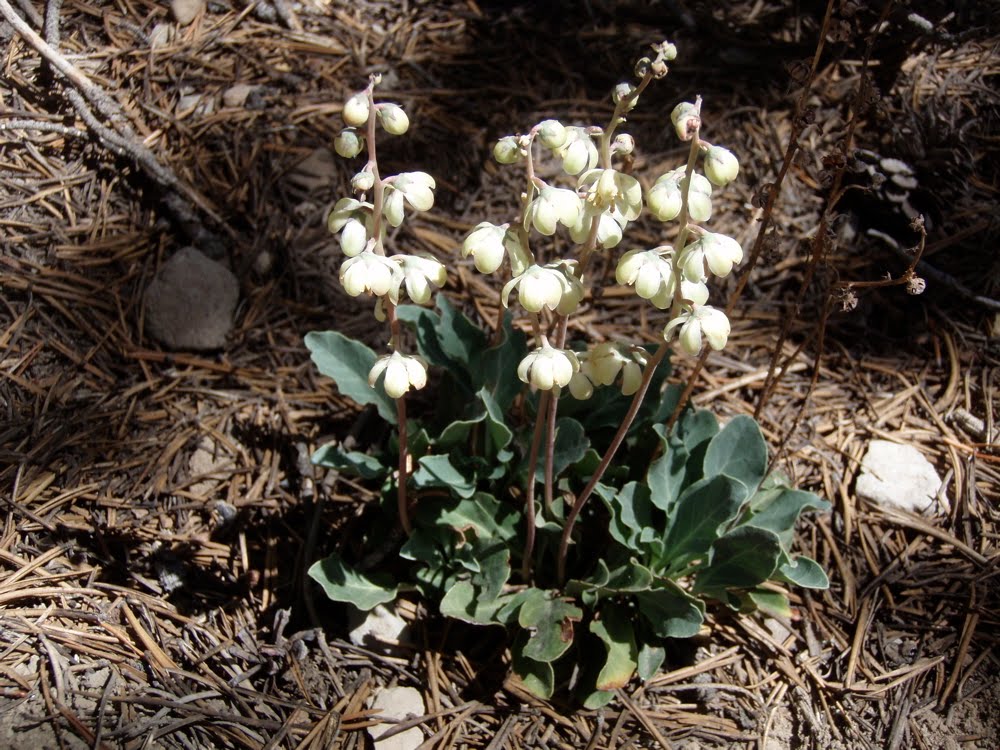 White-veined wintergreen
 Flowers of the white-veined wintergreen
 Leaves with their white veins
7/26/10
A Little Winter in the Summer
 Wintergreen flowers
 Leaf rosette
Wintergreen often grows in large groups because they have extensive rhizomes (underground stems) that sprout plants up all over an area. The bog wintergreen tends to grow in shade and in moist forested areas. Because they are hemi-mycotrophic (partially dependent on fungi), they need a lot of dead wood and compost to create an environment that has just the right balance of fungi and other soil nutrients, otherwise they will not grow.
 Dense clusters of wintergreen plants
The leaves of wintergreen are edible, but they tend to be tough and bitter. It has been used as a broad-spectrum astringent, treating urinary diseases, mouth and throat inflammation, hemorrhoids and insect bites. The leaves leaves are high in methyl salicylate, a natural painkiller.
 Close up of a wintergreen flower
 Wintergreen flowers on the single stem
7/19/10
Watch Out for that Hot-Rock!
 Hot-Rock Penstemon
With my job, I've been seeing a lot of plants I've never seen before and some that I've never even heard of. Hot-Rock Penstemon (Penstemon deustus) is one of the plants that I have never seen or heard of before. I found it while hiking up the Hunter Creek trail. When I first noticed it, it didn't appear that interesting--it looked like a bushy, little, green plant that was just hanging out on the side of the trail. However, when I looked closer, I saw that it had beautiful, little, white and purple flowers and I thought to myself "wow, what could this plant be?"
 Hot-Rock Penstemon flowers
 Hot-Rock Penstemon flower
Hot-Rock Penstemon is a useful plant, it is used for wildlife habitat enhancement and restoration efforts. It is also a popular plant used in xeriscaping. In addition, a poultice of the smashed leaves has been used to aid in the healing of skin sores, such as boils, mosquito bites, tick bites and open sores.
It's fun to see the Hot-Rock Penstemon in nature, because it's so different from most of the penstemon in the area. Many Penstemon tend to have bright purple, pink and/or blue flowers, so the white flowers of the Hot-Rock is quite unique.
Subscribe to:
Posts (Atom)